The Complete Guide to Seed Gravity Separator Machines
In today’s competitive agriculture industry, seed quality plays a crucial role in achieving higher crop productivity. Farmers and seed processing companies rely on advanced equipment to ensure only the healthiest and highest-quality seeds reach the market. One of the most essential machines in any modern seed processing plant is the Seed Gravity Separator Machine.
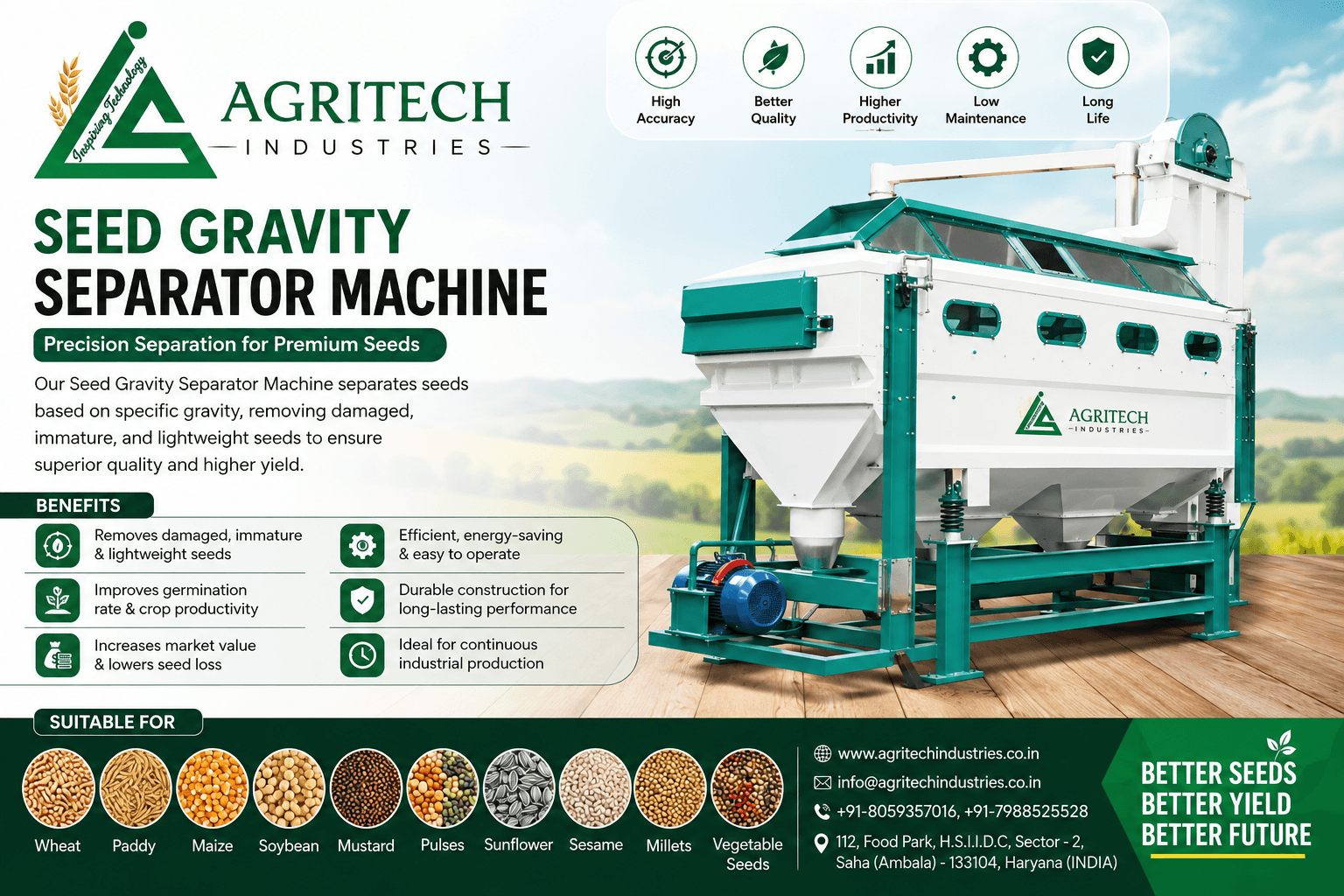
At Agritech Industries, we manufacture advanced seed processing machinery designed to deliver exceptional performance, durability, and precision. Our Seed Gravity Separator Machine helps remove damaged, immature, lightweight, and infected seeds, ensuring premium-quality output for commercial seed production.
What is a Seed Gravity Separator Machine?
A Seed Gravity Separator Machine is an advanced seed cleaning machine that separates seeds based on specific gravity (density) rather than size. Even when seeds appear identical in shape and dimensions, healthy seeds are generally heavier than damaged or immature ones.
The machine creates a controlled combination of:
- Air flow
- Deck vibration
- Inclined gravity table
This enables the heavier seeds to move in one direction while lighter and defective seeds move in another, resulting in highly accurate separation. Gravity separators are widely used for density-based separation of seeds and grains.
Working Principle
The Seed Gravity Separator Machine operates in the following steps:
1. Seed Feeding: Raw seeds are uniformly fed onto the vibrating gravity deck.
2. Air Distribution: A controlled stream of air lifts the seeds slightly.
3. Vibration & Inclination: The vibrating deck separates heavier seeds from lighter seeds according to their density.
4. Final Separation: Different outlets collect:
- Premium quality seeds
- Medium grade seeds
- Damaged seeds
- Dust and impurities
The result is a highly purified seed lot with improved germination performance.
Major Features
- High Separation Accuracy
- Heavy-Duty Steel Construction
- Energy Efficient Design
- Adjustable Airflow Control
- Low Maintenance
- Smooth & Quiet Operation
- Suitable for Continuous Industrial Production
- Long Service Life
Applications
The Seed Gravity Separator Machine is ideal for processing:
- Wheat
- Paddy (Rice)
- Maize (Corn)
- Soybean
- Mustard
- Bajra
- Millet
- Pulses
- Sesame
- Sunflower
- Vegetable Seeds
- Spice Seeds
Benefits of Using a Seed Gravity Separator
- Improved Seed Quality: Removes shriveled, immature, insect-damaged, and lightweight seeds.
- Higher Germination Rate: Only healthy and dense seeds are retained for sowing.
- Better Market Value: Premium-quality seeds command higher prices in the market.
- Reduced Seed Loss: Efficient sorting minimizes wastage.
- Increased Productivity: High-capacity processing saves both time and labor.
Industries Served
Our Seed Gravity Separator Machines are widely used in:
- Seed Processing Plants
- Agricultural Industries
- Seed Production Companies
- Grain Cleaning Units
- Food Processing Industries
- Export Seed Processing Facilities
Why Choose Agritech Industries?
Agritech Industries is committed to delivering reliable seed processing solutions engineered for modern agriculture. Our machines are designed for precision, durability, and operational efficiency, helping customers achieve superior seed quality and consistent performance.
Our Advantages
- Advanced Engineering
- Precision Manufacturing
- High Efficiency Machines
- Robust Construction
- Excellent After-Sales Support
- Customized Seed Processing Solutions
- Competitive Pricing
Conclusion
A Seed Gravity Separator Machine is one of the most valuable investments for any seed processing operation. By separating seeds according to density, it significantly enhances seed purity, germination rate, and overall crop performance. Modern gravity separator technology ensures consistent quality while reducing operational costs and maximizing productivity.